
Soooooooo-lar Power
The energy crisis and the case for putting solar panels on your roof


It is a truth universally acknowledged that a middle aged man in possession of a good house must be in want of some solar panels. Like home brewing and road cycling, the acquisition of a household solar system requires deep research, growing fluency in an unfamiliar technical language and, eventually, buying some shiny new gear. The only thing better than installing solar is forcing your friends to hear about it. The only thing better than that is forcing your substack readers to hear about it too.
How much will it cost? Who are you using? How long will it take to pay itself off? These are all questions you haven’t yet asked but must now surely be realising I am about to answer. In my defence I have, since I started looking into this, come across a wide range of people (albeit in an exceptionally narrow demographic) who have flirted with installing rooftop solar too. This post is for them and people like them. But mostly, of course, it is for me.
The only thing less interesting than hearing about the wattage of somebody’s new solar panels is hearing that they used Artificial Intelligence to help choose them, but I found this to be a rare good use case for Chat GPT (actually Claude, but I’ve been asked “who’s Claude?” so many times it’s easier to say the brand everybody knows). I uploaded my last twelve powerbills and some information about my roof then asked it to write me a report about the financial case for solar. One of the big changes since last time I asked is the availability of a “green loan” from the bank at 1% or sometimes even 0%. The loan must be paid back over five years but that really gives your solar system a good headstart in paying its own way. GPT predicted (after performing a number of complicated and frankly very sexy calculations) that my system would save us enough on our monthly powerbill that in 6.3 years we will pay the system off and start making money. By the time the panels die around 2051 we should be $100,000 up, and that’s assuming pretty conservative price inflation on the grid.
After 13 years of marriage I have learnt that the person least likely to convince my wife of something is me - she suspects, not unreasonably, that I may be withholding or exaggerating information to suit my desired conclusions. She reads for a living and I knew that if I gave her another pdf report it would sit at the bottom of her inbox. So I uploaded GPT’s document to another AI service called Notebook LM which turned it into a podcast conversation she could listen to on the run.
“Hello and welcome to this deep dive into a financial analysis of whether this northwest facing house in Grey Lynn, Auckland should invest in solar,” began a deeply-accented American male.
“That’s right, we’re going to cut through the noise and really look at the case for taking on more debt, for a household already concerned about the size of their mortgage” continued his female friend. “So let’s get right into it.”
Over the next 17 minutes they made a pretty strong argument in favour of the investment, before moving on to the question of whether to buy a battery as well. This got the big thumbs down for a family like us who are motivated almost entirely by financial considerations (the payback on a battery looked to be around 65 years at current numbers, with some strong signs prices will come down in the next few years) but if you were in an area prone to blackouts the rationale would be stronger. The two imaginary podcasters were split over whether it was worth switching our gas hot water heating over to a hot water heat pump at the same time we install solar; so as with our cars we’ve opted to wait for the old system to die before moving to electric.
If you’ve made it this far you only have yourself to blame, as I will now outline some of the other questions people considering solar will or should find themselves asking:
Who should I get quotes from?
I got four quotes: two from big established solar companies, one from more of an up-and-comer, and finally one from a non-specialising electrician with plenty of installs behind him and great reviews online. The up-and-comer was fantastic, replying in a couple of hours with a quote so sharp Chat GPT had to completely revise its calculations. The established guys were solid but there’s a lot of sales and marketing at these places now - you have to put up with someone trying to call you all day and then read through a glossy proposal trying to convince you to do something you’ve already decided to do. Not everyone is like me but I find somebody trying to sell me something exceptionally offputting; still, if you were starting from absolute scratch the handholding and oversupply of info might be appealing.
I narrowed our choice down to the up-and-comer vs the electrician (who both had much cheaper offers anyway) and this morning finally accepted a quote from the latter. You will have your own stylistic preferences but I think the combo of big company/small company/sole trader will give you a nice spread of quotes, and the variance in recommendations should provide you with good questions to ask their competitors.
What exactly am I buying?
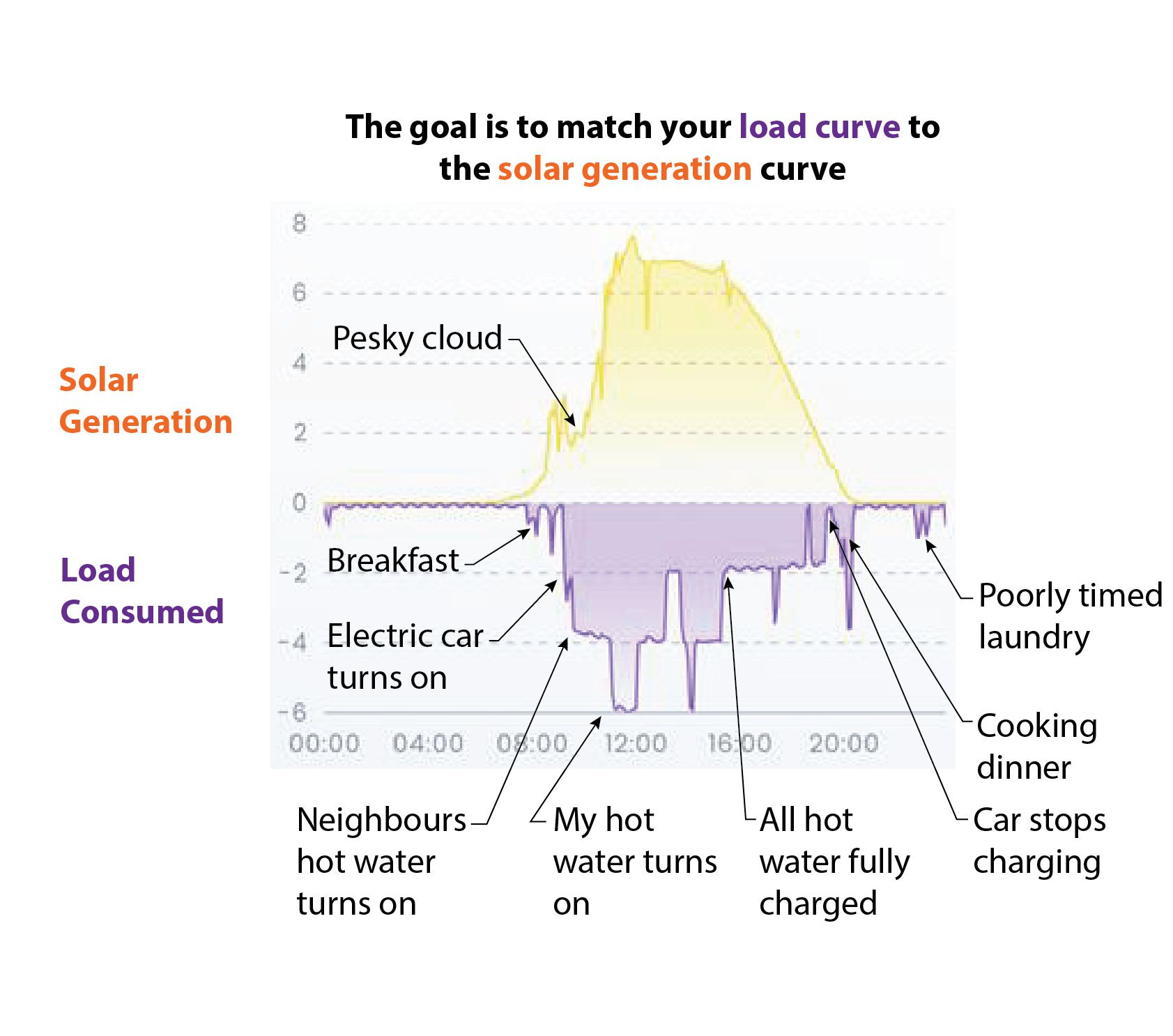
You are (unless you’re doing something wacky based on your home’s weird topography) buying solar panels for your roof along with an “inverter”, an eye-glazing name for the thing that helps turn sunlight into something that can boil your jug. You will (nobody disagrees with this) buy a solar panel system that is a bit bigger than your inverter’s capacity. This is because there are only a few hours a year when the panels will be soaking up their absolute max sunshine so you’d be silly to oversize your inverter just to meet those moments. Instead you size down a bit and put up with losing a bit of energy on those mid-summer days to have an inverter much better matched to your system most of the time. I’ve gone with 13.3kW of generation with a 10kW inverter which may be pushing the mismatch a little but I’ve configured them a bit unusually so I’m an exception.
Where will the panels go?
On your roof facing north, or as north as your roof can get. But hey, I got yarning to a guy from Vector who had the quite crafty idea of having some of his panels face in the dreaded south/east direction. Because they’ll face away from the sun a lot of the time they won’t reach their full potential (for this reason my electrician wasn’t keen on them) BUT as the sun is coming up and we need to use the toaster and the top performing north facing panels haven’t kicked in yet I quite like the idea of having some early morning generation to avoid us buying off the grid. So I overruled my installer’s advice and decided to go with 23 panels on the northwest and 5 on the southeast. I then asked GPT if it could write me an email explaining this decision to our electrician “with appropriate deference to his expertise” and it really overglazed it, crafting a message so effusive it sounded like I was falling in love with the guy. I rewrote it and he seemed to take my decision fairly well.
You can play around with your own address and different configurations with a great Aussie tool here though you may want some GPT help filling out some of the fields.
What brand of panels/inverter should I go with?
Even I’m not interested enough in this question to spend much time on it. Whoever you go with will have their own favourite brands and my assumption is if you trust your installer you can trust their choice in equipment too. Note most of the advances in technology lately is in how much energy one panel can produce (when I got quoted in 2021, 385w per panel was standard; the ones I’ve just said yes to are 475w per panel) so do check this part is looking right. If you want further brand comparison and analysis you will need to find a substack even more insufferable than this one.
[post publication edit: the great Lindsay Wood of Climate Matters says “I’d like to point out that, for anyone wishing to install a battery in the future, it’s worth investing up front in a “hybrid” inverter, which would then allow their system to keep running on batteries when the main power system was down. (The point being that when there’s a fault on the mains, to avoid feeding power into a faulty grid, PV systems have to shut down unless they have a hybrid inverter that allows them to switch over to running off batteries alone.)]
How long will the installation take?
Make sure you ask this question. Up-and-comer promised a couple of weeks, the established guys more like 2-3 months. A friend has just got her deposit back from an installer who took the money six months ago and hasn’t been able to find warm bodies to do the job. It would be quite depressing, I think, to experience the thrill of accepting the quote and then find nothing was going to happen until at least the end of winter.
What power company will you go with?
This is quite important and crucial to the number crunching. On a sunny day when you’re not using much electricity, the excess units you produce will be sold back to your power company, so it’s good to choose someone paying a decent rate. The two best bets for solar seem to be Octopus and Ecotricity, though the former has a rule that once your system gets to a certain size they bump you onto a lower offpeak rate so it looks as though Ecotricity will be the one to go for. It’s worth remembering that you make the most money when you use the sun to replace a unit you would otherwise have bought from the grid; selling sunlight back to your power company is less lucrative and harder to predict the future market for. At some point we may all be producing so much energy at lunchtime the power company gets no benefit from buying it, and who could blame them.
That’s all the questions I can think of but if you want to ask me anything drop me a note. I am not an expert in solar but I am an expert in being an amateur searching for expertise.
********************
Something funny is happening out there. I’ve never heard this many people talking about considering a home solar system, and since engaging with my electrician he’s been getting increasingly worried about finding the materials to do the job. By the time I was ready to give him the thumbs up yesterday, the panels he’d initially quoted me on had sold out. He promised to try another supplier and when I told him “yes please, grab 28 of them for me while you can”, he called back and said the guy had exactly 28 left, and we’d nabbed them. Another friend relayed a similar message from his own installer: if you think you might want solar, call this afternoon.
The cynical among you might wonder if this panicky call-to-action was just a clever way to close a sale but I have the strong sense it’s based on a genuine rush out there. We’ve already seen news that electric vehicles are selling faster since the war began - manufacturer BYD reports that on one day recently they sold six times as many plug in cars as usual. Meanwhile, Business Desk notes that the day after Finance Minister Nicola Willis gave her livestreamed press conference on the fuel crisis, Auckland Transport had its busiest day of the year.
If the prospect of oil price hikes and shortages is enough to tip people on the brink of behaviour change into the world of renewables and self-sufficiency then maybe there’ll at least be one positive outcome from the Iran conflict. They say it’s not New Zealand’s war and that there’s nothing we can do about it but, of course, we can remember this feeling of vulnerability and act decisively to insulate ourselves against the next time it happens. For individuals and the government the trick might be to make changes right now while we’re in the middle of it, rather than trust ourselves to remember how this feels once things return to normal.
An absolutely awesome and hilarious article whuch echoes my family situation very well. Thank you!
We have had solar for 3 years now without a battery which are just not financially viable and we love having it. Our bill was $6 last month. It's well worth buying a Catchpower device which very cleverly diverts surplus power to your hot water cylinder before it sends any back to the grid. Given hot water can be up to 30% of the bill this makes huge sense and your cylinder then acts like a low cost battery. The interesting thing we have found is that people only ask how long it will take to pay it off. My reply is always that's a small factor compared to the immense satisfaction of doing something worthwhile for our struggling planet. Why our crazy government is building a gas terminal in Taranaki at vast expense instead of subsidising solar never ceases to amaze me but I suppose most of them and their mates have fuel company shares to go with their rentals.